


Education
ACCA FR 2026: The Complete Guide to Passing Financial Reporting
Financial Reporting is the paper that decides how the rest of your ACCA goes. Pass it properly and SBR becomes manageable. Scrape through it on memorised formats and SBR will find every gap you left behind.
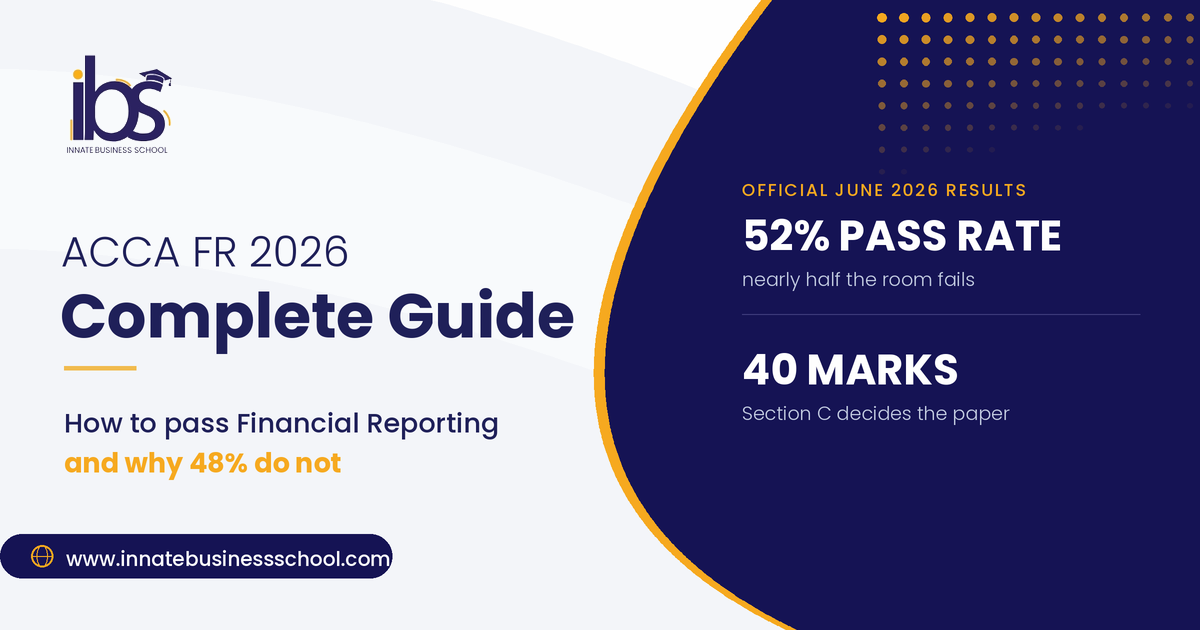
ACCA's official pass rate for FR in June 2026 was 52%, and across the last five sittings it has sat between 48% and 52%. Just under half the people who walk into that exam do not come out with a pass.
This guide covers what FR actually tests, where the marks are, the five reasons candidates fail, and a study plan for the December 2026 and March 2027 sittings.
If you are sitting in December, standard entry closes on 2 November 2026, which is twenty days away.
What FR Actually Tests
FR is a three hour computer based exam worth 100 marks, split across three sections.
| Section | Format | Questions | Marks |
|---|---|---|---|
| A | Objective test questions | 15 single OTs, 2 marks each | 30 |
| B | OT case questions | 3 cases, 5 OTs each | 30 |
| C | Constructed response | 2 questions, 20 marks each | 40 |
The syllabus covers four areas: the conceptual and regulatory framework, applying IFRS standards to transactions, preparing financial statements including groups, and analysing and interpreting those statements.
Section C carries 40% of the marks in two questions. That is where the paper is won or lost.
Section C Is the Exam
Almost every FR sitting puts the same two topics in Section C.
Consolidation. A group question requiring a consolidated statement of financial position or statement of profit or loss. This is the most technically demanding thing in the paper: goodwill, non controlling interest, intra group eliminations, and the pre and post acquisition split of retained earnings.
Interpretation and analysis. A question giving you a set of financial statements and asking you to calculate ratios and comment on performance.
Those two questions are 40 marks. A candidate who is genuinely fluent in consolidation and who can write interpretation commentary tied to actual figures has 40 marks largely secured before the exam starts. A candidate who is shaky on either is relying on Sections A and B to carry them, and 60 marks of objective testing is a thin margin.
For the standards themselves, the complete guide to all ACCA papers sets FR in the context of the wider qualification.
The Five Reasons Candidates Fail FR
1. Consolidation worked from memory rather than understanding
Students memorise the goodwill proforma and then meet a question with mid year acquisition, contingent consideration or fair value adjustments and the proforma does not fit. Goodwill, NCI and the retained earnings split have to be understood as mechanics, not recalled as a layout.
The fix is volume. Work twenty consolidation questions, not three. The patterns only become visible once you have seen the variations.
2. Interpretation answers that are not tied to the numbers
This is the single most common way to lose easy marks. “Profitability has declined, which may indicate inefficiency” earns almost nothing. “Gross margin fell from 42% to 31%, and since revenue grew 8% the fall is driven by cost of sales, which rose 29%, consistent with the raw material price increase in note 4” earns the marks.
Every sentence of commentary needs a number from the scenario attached to it.
3. Avoiding the standards that feel uncomfortable
Three recur in examiner feedback year after year: IFRS 16 lessee accounting, IAS 16 revaluation and the transfer of revaluation surplus, and IAS 12 deferred tax. Students skip deferred tax in particular and hope it stays in Section A. It does not.
4. Running out of time in Section C
Spending too long on Sections A and B is the classic FR failure. The objective tests feel productive because you are answering constantly, and then forty minutes remain for two twenty mark questions.
5. Reading notes instead of working questions
Reading a chapter on groups does not teach consolidation. Producing a consolidated statement of financial position does. After your first pass through a topic, practice is the only thing that moves the mark.
The Time Budget That Beats FR
Three hours, 100 marks, so 1.8 minutes per mark. Apply it mechanically.
| Section | Marks | Time allowed | Checkpoint |
|---|---|---|---|
| A | 30 | 54 minutes | 54 minutes gone |
| B | 30 | 54 minutes | 108 minutes gone |
| C | 40 | 72 minutes | 180 minutes |
That is 36 minutes per Section C question and 3.6 minutes per objective test question.
The discipline that matters: when 108 minutes have passed, you move to Section C whether or not Sections A and B are finished. An unanswered twenty mark question scores zero. A flagged objective test you guessed still has a one in four chance.
More tactics for Pakistani students, including studying around load shedding, are in our ACCA exam preparation guide.
A Study Plan for FR
FR needs roughly 150 to 180 hours. What that means depends on your sitting.
| Sitting | Weeks from today | Hours per week at 150 | At 180 |
|---|---|---|---|
| December 2026 | 8 | 19 | 23 |
| March 2027 | 20 | 8 | 9 |
Eight weeks at nineteen hours is demanding alongside a job. Twenty weeks at eight hours is comfortable. If you are weighing December against March, that table is the honest answer.
A ten week structure that works:
| Weeks | Focus |
|---|---|
| 1 to 2 | Conceptual framework, single entity accounts, IAS 16 and IFRS 15 |
| 3 to 4 | IFRS 16, IAS 12 deferred tax, IAS 36, provisions |
| 5 to 6 | Consolidation, statement of financial position |
| 7 | Consolidation, profit or loss and associates |
| 8 | Interpretation and ratio analysis |
| 9 | Full past papers under exam conditions |
| 10 | Mock, marked feedback, fix the weak areas |
Weeks 5 to 8 carry the Section C marks. If your schedule slips, protect those four weeks and compress elsewhere.
What Failing FR Actually Costs
| Item | PKR |
|---|---|
| Exam entry, standard | 61,600 |
| Exam entry, late | 157,465 |
| Late entry penalty | 95,865 |
| One resit, all in | 140,500 |
The resit figure includes the exam fee again, re tuition of around PKR 25,000 and the risk of an extra annual subscription. It does not include the three to four months you lose.
At a 52% pass rate, the average FR candidate pays for the paper 1.9 times, which is roughly PKR 118,462 in exam fees alone. Every fee in rupees is in our ACCA cost breakdown.
FR Becomes E2 in 2027
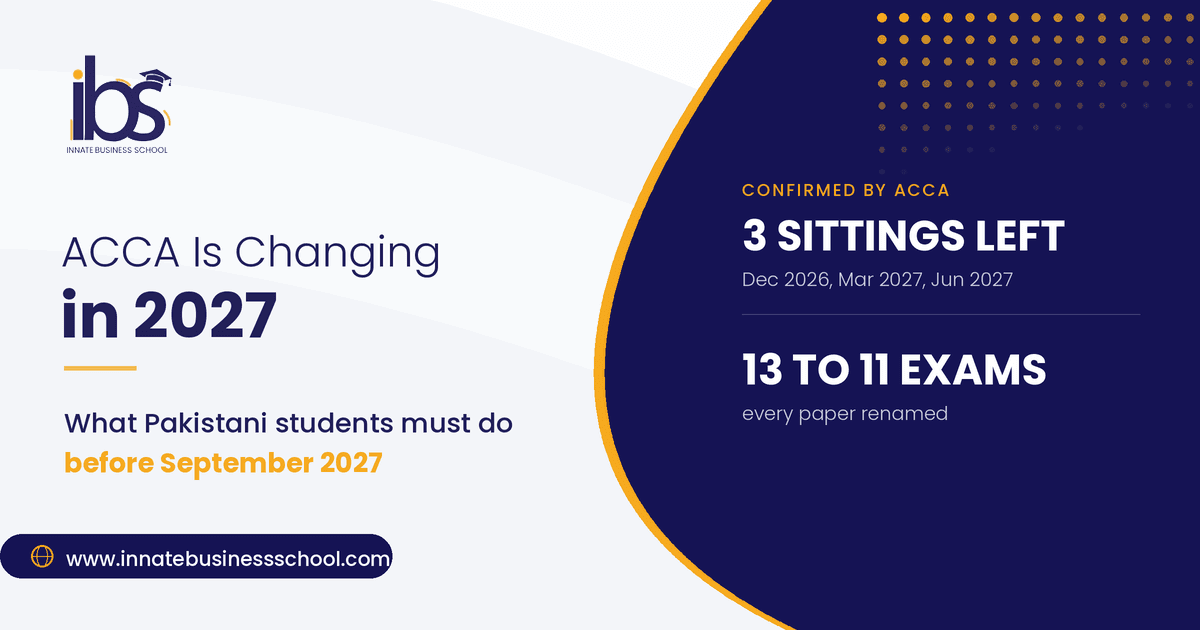
ACCA is redesigning the qualification. Under the new structure, FR becomes E2 Financial Reporting at the Expertise level, and your pass carries over with no loss.
What matters for timing: June 2027 is the last session at which you can complete all Applied Skills exams under current rules. If you have not finished the level by then, you must complete a chargeable module of roughly 100 hours before entering Strategic Professional exams.
If FR is one of your last Applied Skills papers, clearing it in December 2026 or March 2027 keeps you comfortably ahead of that deadline. The ACCA exam dates and deadlines guide has every confirmed date.
FR Is the Door to SBR
SBR assumes FR. Consolidation, the standards, and the ability to explain an accounting treatment in writing all carry straight through, at a harder level and with more judgement required.
Students who pass FR by memorising formats tend to struggle in SBR, because SBR rarely asks for a format. It asks why a treatment is correct. The understanding you build in weeks 5 to 8 above is the understanding SBR tests.
If SBR is your next paper, our complete SBR guide covers syllabus, answer technique and the mistakes that recur every session.
Studying FR With IBS
FR is taught at IBS by Sir Yasir Yamin, ACA, FCCA, FCMA, with over fifteen years teaching ACCA. Each course runs recorded lectures plus a weekly live session, with 120 days of access.
Four FR courses are open, by language and sitting:
| Course | Language | Sitting |
|---|---|---|
| Financial Reporting, December 2026 | English | Dec 2026 |
| Financial Reporting, December 2026 | Urdu and Hindi | Dec 2026 |
| Financial Reporting, March 2027 | English | Mar 2027 |
| Financial Reporting, March 2027 | Urdu and Hindi | Mar 2027 |
Courses are built for a named sitting rather than a generic syllabus, which matters for FR because the standards examinable change between sessions.
Want a free FR study plan for your sitting? Send us your exam date and how many hours a week you have, and we will map the ten week structure above onto your actual calendar. WhatsApp +92 329 048 9489.
Frequently Asked Questions
52% in ACCA's official June 2026 results. Across the last five sittings it has ranged between 48% and 52%, making FR one of the more passable Applied Skills papers but still a paper nearly half of candidates fail.
It is technically demanding rather than conceptually difficult. The challenge is consolidation and the volume of standards, both of which respond to question practice far more than to reading.
Between 150 and 180. That is around nineteen hours a week for December 2026, or eight a week for March 2027.
Three hours, 100 marks. Section A has 15 objective tests worth 30 marks, Section B has three case based sets worth 30 marks, and Section C has two constructed response questions worth 20 marks each.
Consolidation and interpretation, in almost every sitting. Together they are 40 marks.
Yes. FR is the technical foundation SBR builds on. Skipping or scraping FR makes SBR considerably harder.
FR becomes E2 Financial Reporting at the new Expertise level. A pass in FR carries over with no loss.
Yes. IBS runs FR in both English and Urdu and Hindi for the December 2026 and March 2027 sittings. The exam itself is written and marked in English, so practice answers should be written in English whichever language you learn in.
ACCA Is Changing in 2027: What Pakistani Students Must Do Before September 2027
ACCA is changing in 2027. Learn how passed papers carry over, which deadlines matter, and how Pakistani students can pla...

ACCA Exam Preparation Tips for Pakistani Students 2026
Practical ACCA exam preparation tips for Pakistani students: study hours, mock exams, paper combinations, resit costs an...
 Join WhatsApp Community