


Education
Complete Guide to All ACCA Papers in 2026
Understanding the full structure of ACCA papers is the most important thing you can do before beginning your ACCA journey. Students who understand what they are walking into - the 13 papers, three levels, exam formats, difficulty curve, exemption system, and smart sequencing - pass faster and with significantly less stress.
If you are also wondering about the scope of ACCA in Pakistan including salaries, job roles, and career paths, we have a detailed guide covering that.
This guide covers everything: not just paper names, but what each paper actually tests, how difficult it is, how long to study for it, when to attempt it, and what it means for your career.
The ACCA Qualification: The Big Picture
ACCA (Association of Chartered Certified Accountants) consists of 13 papers divided across three levels, plus a Practical Experience Requirement (PER) of 36 months and an Ethics & Professional Skills Module (EPSM). Together, these qualify you as a full ACCA Member.
- Applied Knowledge - 3 papers (foundational)
- Applied Skills - 6 papers (technical depth)
- Strategic Professional - 4 papers (2 compulsory + 2 optional from 4 choices)
Exam sessions are held four times per year: March, June, September, and December. Applied Knowledge papers are also available on demand year-round.
All 13 ACCA Papers at a Glance
| Level | Code | Paper Name | Format | Duration |
|---|---|---|---|---|
| Applied Knowledge | BT / F1 | Business and Technology | CBE (on-demand) | 2 hours |
| Applied Knowledge | MA / F2 | Management Accounting | CBE (on-demand) | 2 hours |
| Applied Knowledge | FA / F3 | Financial Accounting | CBE (on-demand) | 2 hours |
| Applied Skills | LW / F4 | Corporate and Business Law | CBE (session) | 2 hours |
| Applied Skills | PM / F5 | Performance Management | CBE (session) | 3 hrs 15 min |
| Applied Skills | TX / F6 | Taxation | CBE (session) | 3 hrs 15 min |
| Applied Skills | FR / F7 | Financial Reporting | CBE (session) | 3 hrs 15 min |
| Applied Skills | AA / F8 | Audit and Assurance | CBE (session) | 3 hrs 15 min |
| Applied Skills | FM / F9 | Financial Management | CBE (session) | 3 hrs 15 min |
| Strategic Prof. | SBR | Strategic Business Reporting | CBE (session) | 3 hrs 15 min |
| Strategic Prof. | SBL | Strategic Business Leader | CBE (session) | 4 hours |
| Optional (pick 2) | AFM / P4 | Advanced Financial Management | CBE (session) | 3 hrs 15 min |
| Optional (pick 2) | APM / P5 | Advanced Performance Management | CBE (session) | 3 hrs 15 min |
| Optional (pick 2) | ATX / P6 | Advanced Taxation | CBE (session) | 3 hrs 15 min |
| Optional (pick 2) | AAA / P7 | Advanced Audit & Assurance | CBE (session) | 3 hrs 15 min |
Level 1: Applied Knowledge Papers (3 Papers)
These papers build your foundational understanding of business, accounting, and finance. Students with a business or commerce background typically find them manageable with 4–6 weeks of focused study per paper.
BT / F1 - Business and Technology
What it covers: How organisations work, organisational structure, governance, ethics, leadership and management theories, HR, and information technology in business.
Who it is for: Students completely new to business. This paper gives you the conceptual vocabulary you will use throughout the entire ACCA qualification.
Exam format: 100% objective test (MCQs and multi-part questions). No open-ended writing required.
Difficulty: Low - the most straightforward paper in the qualification.
Recommended study time: 60–80 hours
IBS Tip: Do not underestimate BT because it is 'easy.' The concepts of governance, ethics, and organisational management reappear in SBL at the Professional level. Build your understanding properly from the start.
Career relevance: Lays the groundwork for understanding the business environment in which every finance professional operates.
MA / F2 - Management Accounting
What it covers: Costing methods (absorption, marginal, activity-based), variance analysis, budgeting, performance measurement, decision-making techniques (relevant costing, linear programming, throughput accounting).
Who it is for: Students pursuing any finance, accounting, or business role where internal reporting and cost control matter - which is almost every finance role.
Exam format: 100% objective test (MCQs). Strong quantitative focus.
Difficulty: Low to medium. Heavily calculation-based; students with a good grasp of maths find this paper very manageable.
Recommended study time: 80–100 hours
IBS Tip: Practice calculations from Day One. Do not just read through the formulas - apply them under timed conditions. The PM paper at Applied Skills level builds directly on everything in MA.
Career relevance: Management accounting is one of the most employable skills in Pakistan's corporate sector. Finance teams in manufacturing, FMCG, and banking use these techniques daily.
FA / F3 - Financial Accounting
What it covers: The conceptual framework of financial reporting, double-entry bookkeeping, preparing financial statements (income statement, statement of financial position, cash flow statement), group accounts basics, and interpretation.
Who it is for: Anyone. Financial accounting is the core language of business.
Exam format: 100% objective test. Mix of theory and calculation.
Difficulty: Low to medium. The double-entry system can confuse students initially but clicks quickly with practice.
Recommended study time: 80–100 hours
IBS Tip: Master the double-entry system completely before moving on. Every ACCA paper from FR onwards assumes you can think in debits and credits instinctively. Students who are shaky on FA foundations typically struggle at FR.
Career relevance: Financial accounting is the bedrock of every accounting and finance role. Mastering it here pays dividends throughout your career.
Level 2: Applied Skills Papers (6 Papers)
The Applied Skills level is where ACCA gets genuinely challenging. These six papers require you to apply knowledge rather than just recall it. Exams are 3 hours 15 minutes with a mix of MCQs and written constructed-response questions.
LW / F4 - Corporate and Business Law
What it covers: The English legal system, contract law, company law (formation, administration, management, dissolution), employment law, insolvency, and legal obligations of accountants.
Who it is for: All ACCA students. Legal literacy is essential for every finance professional.
Exam format: 100% objective test in Pakistan (English law variant). Some variants include written responses.
Difficulty: Medium. Heavy on memorisation of legal principles and case law concepts.
Recommended study time: 100–120 hours
IBS Tip: Use structured summary notes for each area of law. The sheer volume of content is what trips students up, not its complexity. Organise your revision around topic chunks and test yourself with past papers.
Career relevance: Finance professionals who understand company law and contract law are significantly more valuable to employers. Governance, compliance, and corporate roles all draw on LW knowledge.
PM / F5 - Performance Management
What it covers: Advanced cost accounting, activity-based management, performance measurement (balanced scorecard, KPIs), divisional performance (ROI, RI, EVA), pricing strategies, risk and uncertainty in decision-making.
Who it is for: Students targeting management accounting, business partnering, or FP&A roles.
Exam format: Mixed format - Section A (MCQs) and Sections B & C (constructed response, scenario-based questions).
Difficulty: Medium to high. Scenario-based questions require applying techniques in realistic business contexts, not just calculating.
Recommended study time: 130–150 hours
IBS Tip: PM is a paper where rote learning will fail you. Practice writing answers to scenario questions and develop the habit of linking your calculations to strategic recommendations. Exam technique matters as much as technical knowledge.
Career relevance: PM skills are directly used in budgeting, management reporting, KPI design, and business case development - functions central to every finance team.
TX / F6 - Taxation
What it covers: Pakistan income tax (individuals and companies), sales tax, withholding tax, tax planning, tax returns, and the role of tax professionals. The Pakistan variant covers Pakistani tax law.
Who it is for: All ACCA students in Pakistan. Updated tax law changes each year, so you need a current study text.
Exam format: Mixed format - MCQs plus constructed response questions including tax computation scenarios.
Difficulty: Medium. The rules and calculations are learnable, but the volume of detail is significant.
Recommended study time: 130–150 hours
IBS Tip: Tax law changes annually in Pakistan's Finance Acts. Make sure your study materials are updated for the current tax year. Practice full tax computations under timed conditions repeatedly - this is where marks are won and lost.
Career relevance: Tax knowledge opens a lucrative career path in Pakistan. Tax consultancies, Big Four tax departments, and in-house tax roles all offer strong compensation and consistent demand.
FR / F7 - Financial Reporting
What it covers: IFRS standards in depth - revenue recognition (IFRS 15), leases (IFRS 16), financial instruments (IFRS 9), provisions (IAS 37), impairment (IAS 36), group accounts (consolidation, associates, joint arrangements), financial statement analysis.
Who it is for: Students who want to work in audit, financial reporting, or any role requiring deep understanding of financial statements.
Exam format: Mixed format - Section A (MCQs) and Sections B & C (scenario-based constructed response, including full group accounts).
Difficulty: High. FR is one of the most challenging Applied Skills papers. Group accounts questions are technically demanding and time-pressured.
Recommended study time: 150–180 hours
IBS Tip: Start practising group accounts (consolidation) early. Many students leave this topic too late and run out of time in the exam. Understanding the 'why' behind each IFRS standard - not just the rules - helps you answer application questions properly.
Career relevance: FR knowledge is essential for audit, financial reporting, and controller roles. IFRS is the reporting framework used by every listed company in Pakistan and throughout the Gulf.
AA / F8 - Audit and Assurance
What it covers: The audit process from planning to completion, risk assessment (inherent, control, detection risk), internal controls, substantive testing, going concern, audit reports, professional ethics for auditors.
Who it is for: Students targeting external audit careers (Big Four, mid-tier firms) or internal audit roles.
Exam format: Mixed format - MCQs plus scenario-based constructed response. Heavy emphasis on professional judgement and communication.
Difficulty: Medium to high. Application questions require you to think as a practising auditor, not just recall procedures.
Recommended study time: 130–150 hours
IBS Tip: Read audit questions carefully for the scenario context. The examiner rewards answers that reference the specific circumstances in the question - generic audit procedures score poorly. Practice writing professional, structured answers.
Career relevance: Audit is the most common entry path for ACCA graduates in Pakistan. Big Four trainee positions at EY, PwC, Deloitte, and KPMG are competitive but enormously valuable for career development.
FM / F9 - Financial Management
What it covers: Investment appraisal (NPV, IRR, MIRR, payback), working capital management, business finance (equity, debt, WACC), business valuations, risk management (currency risk, interest rate risk), and financial planning.
Who it is for: Students targeting corporate finance, treasury, investment banking, or senior finance roles.
Exam format: Mixed format - MCQs plus scenario-based constructed response. Heavily quantitative.
Difficulty: Medium to high. FM is calculation- intensive and covers a wide range of topics. Time management in the exam is critical.
Recommended study time: 140–160 hours
IBS Tip: Build a clean formula sheet early and practice every major topic type under timed conditions. FM calculations under time pressure are where marks are regularly lost. AFM at the Professional level is a direct extension of FM, so a solid FM foundation pays double dividends.
Career relevance: FM skills are central to treasury, corporate finance, investment decision-making, and CFO-level thinking. Mastering FM is genuinely career-accelerating.
Level 3: Strategic Professional Papers (4 Papers)
The Strategic Professional level is the summit of the ACCA qualification. These papers test strategic thinking, professional judgement, and the ability to synthesise complex information. Exams are longer (3–4 hours), scenarios are more complex, and marking rewards quality of thinking over volume of content.
SBR - Strategic Business Reporting (Compulsory)
What it covers: Advanced IFRS reporting, complex group structures, ethical issues in financial reporting, emerging areas of reporting (integrated reporting, sustainability reporting), current developments in the profession.
Who it is for: All ACCA students. SBR is compulsory.
Exam format: 100% constructed response. Scenario-based questions requiring professional-level analysis and written communication.
Difficulty: Very high. SBR requires applying IFRS to novel, complex scenarios and communicating analysis professionally. No easy marks from memorisation alone.
Recommended study time: 200+ hours
IBS Tip: SBR rewards students who genuinely understand accounting standards rather than those who have memorised rules. Practice reading complex scenarios and planning answers before writing. Quality of analysis matters more than length.
Career relevance: SBR directly qualifies you to prepare and advise on complex financial reports - a capability valued at senior levels in audit, financial reporting, and corporate advisory.
SBL - Strategic Business Leader (Compulsory)
What it covers: Strategic analysis and planning, governance and ethics, risk management, digital transformation, leadership and people management, project management, professional skills integration across all ACCA competencies.
Who it is for: All ACCA students. SBL is compulsory.
Exam format: A single integrated case study exam (4 hours). Students receive a pre-released case study before the exam session.
Difficulty: Extremely high. SBL is the most complex exam in ACCA, testing integrated professional competency, not any single technical skill.
Recommended study time: 200+ hours
IBS Tip: Read the pre-released case study thoroughly and deeply. The exam questions are entirely based on that case, and students who know it well have a decisive advantage. SBL rewards structured, logical thinking and professional communication above all else.
Career relevance: SBL develops the strategic, leadership, and governance skills that define CFO-level and board-level finance professionals.
Optional Papers (Choose 2 from 4)
- AFM / P4 - Advanced Financial Management: Advanced investment appraisal, corporate restructuring, M&A, international financial management. Best for: corporate finance, treasury, investment banking. Difficulty: Very high. Study: 200+ hours.
- APM / P5 - Advanced Performance Management: Strategic performance measurement, complex organisations, quality and environmental management accounting. Best for: management consulting, FP&A leadership. Difficulty: High. Study: 180–200 hours.
- ATX / P6 - Advanced Taxation: Complex tax planning, international tax, transfer pricing, anti-avoidance. Best for: senior tax advisory. Difficulty: High. Study: 180–200 hours.
- AAA / P7 - Advanced Audit & Assurance: Complex audit engagements, quality management, specialist reporting, current auditing issues. Best for: audit manager and partner career tracks. Difficulty: High. Study: 180–200 hours.
ACCA Exam Exemptions in Pakistan
| Qualification | Typical Exemptions | Papers Remaining |
|---|---|---|
| B.Com (recognised university) | Up to 9 papers | 4 papers to sit |
| BBA Finance (recognised university) | Up to 9 papers | 4 papers to sit |
| CA Foundation (ICAP) | 5–7 papers | 6–8 papers to sit |
| A Levels / Higher Secondary | 0 papers | 13 papers to sit |
| Intermediate / FSc / FA | 0 papers | 13 papers to sit (start from BT) |
Use the official ACCA exemption calculator at accaglobal.com, or speak to an IBS advisor who can identify your precise starting point. Note: exemptions cost money (the same as sitting the paper), so evaluate carefully whether an exemption or sitting the paper gives you a better outcome.
Smart Paper Sequencing: The IBS Recommended Path
Start with Applied Knowledge (any order):
BT → MA → FA (complete all three before moving to Applied Skills)
Applied Skills (recommended groupings):
- LW → FR → AA (audit and financial reporting together)
- TX → PM → FM (tax and management together)
- Avoid sitting FR and FM simultaneously - both are calculation-heavy and demanding. Space them at least one session apart.
Strategic Professional:
SBR and SBL can be attempted together or sequentially. Most students attempt one per session to ensure adequate preparation for each. Choose optional papers based on your career path.
ACCA Fees in Pakistan: What to Budget (2026)
| Fee Type | Approximate Amount (PKR) |
|---|---|
| Initial registration fee | PKR 20,000 – 25,000 |
| Annual subscription | PKR 15,000 – 18,000 |
| Applied Knowledge exam fee (per paper) | PKR 30,000 – 35,000 |
| Applied Skills exam fee (per paper) | PKR 45,000 – 50,000 |
| Strategic Professional exam fee (per paper) | PKR 60,000 – 70,000 |
| Ethics & Professional Skills Module (EPSM) | PKR 8,000 – 10,000 |
| Total (13 papers, no exemptions) | PKR 700,000 – 900,000 (over 3–4 yrs) |
| Total (with 9 exemptions) | PKR 300,000 – 400,000 (over 2–3 yrs) |
Note: These figures do not include tuition costs. IBS offers competitive, session-based pricing for each paper - speak to our advisors for current course fees.
How to Prepare for ACCA Papers: Proven Strategies
- Study to the official ACCA syllabus, not just a textbook. Read ACCA Examiner's Reports after each session - they tell you exactly what common mistakes candidates make.
- Attempt questions before reading the answer. The single most effective ACCA study habit is attempting past questions under exam conditions before you see the solution.
- Manage your time during exams ruthlessly. Many ACCA failures are time management failures, not knowledge failures. Practise allocating exactly the right time per mark in every mock.
- Do not skip the Ethics and Professional Skills Module (EPSM). It is compulsory and the skills it develops are tested within SBL.
- Choose quality tuition. ACCA pass rates improve significantly with an experienced, structured tuition provider. At IBS, our iPass Guarantee reflects our confidence in our teaching - and our commitment to staying with you until you succeed.
Frequently Asked Questions
13 papers in total (unless you receive exemptions), plus the EPSM and 36 months of practical experience to become a full ACCA Member.
ACCA allows up to four papers per session, but most students manage 2–3 comfortably. Attempting more risks spreading preparation too thin.
50% in all papers.
There is no limit on retakes, but retake fees are charged each time. Strong preparation upfront is significantly more cost-effective.
Based on historical global pass rates, the most challenging papers are typically SBL, SBR, AFM, and AAA. FR and PM are also considered demanding at the Applied Skills level.
Yes - and IBS is specifically built for online learners. Live sessions, recorded lectures, past paper practice, and WhatsApp tutor support are all available fully online, whether you are in Karachi, Lahore, Islamabad, or anywhere in the world.
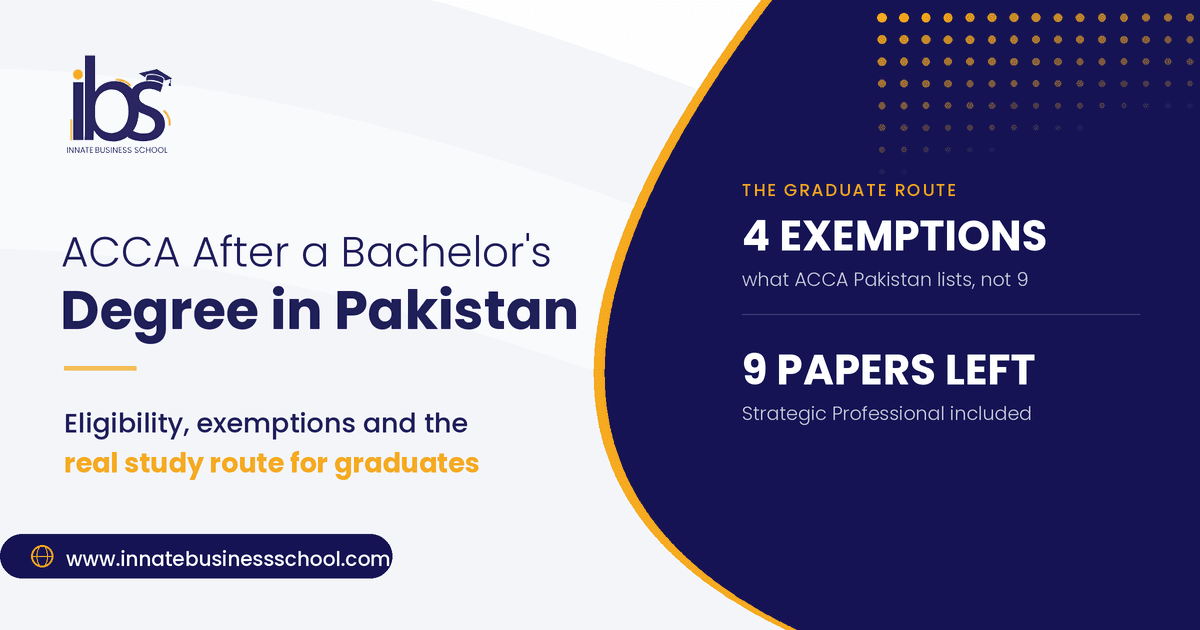
ACCA After a Bachelor's Degree in Pakistan 2026: Eligibility, Exemptions and Study Route
Explore ACCA after a bachelor's degree in Pakistan: eligibility, exemptions, papers, costs and a practical study route f...

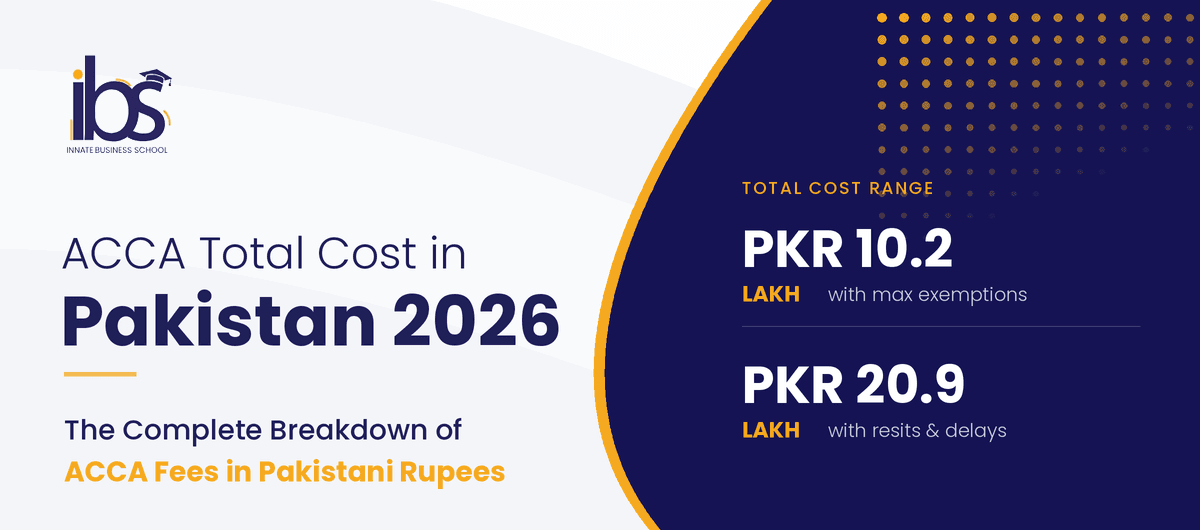
ACCA Total Cost in Pakistan 2026: Full PKR Breakdown
ACCA total cost in Pakistan 2026: PKR 10.2 to 20.9 lakh. Full per-paper fee breakdown in rupees, exemption costs, hidden...
 Join WhatsApp Community