


Education
ACCA SBR 2026: The Complete Guide to Strategic Business Reporting
Strategic Business Reporting (SBR) is one of the two compulsory papers at the Strategic Professional level of the ACCA qualification. For most students, it is the first paper they encounter at this level, and it is a significant step up from the Applied Skills papers they have completed before it.
This guide gives you everything you need to understand SBR properly: what it actually tests, how the exam works, which IFRS standards appear most frequently, how to build a study plan, how to write answers that score, common mistakes to avoid, and how IBS prepares students for both the September 2026 and December 2026 sittings.
If you are searching for a surface-level overview, this is not that guide. If you want to genuinely understand SBR and what it takes to pass it, read on.
What is ACCA SBR? Understanding the Big Picture
SBR stands for Strategic Business Reporting. As the name suggests, it is not a paper about crunching numbers. It is about understanding, applying, and communicating financial reporting information at a strategic level.
Where Financial Reporting (FR/F7) asked you to prepare financial statements and apply IFRS rules mechanically, SBR asks you to go much further. In SBR, you are expected to:
- Analyse and explain financial information to a range of different stakeholders
- Evaluate the impact of transactions on financial statements and on stakeholder decisions
- Apply IFRS standards to complex, unfamiliar scenarios rather than textbook examples
- Assess the ethical and professional dimensions of corporate reporting decisions
- Discuss current developments in reporting including sustainability and integrated reporting
- Produce professional-quality written communication, not just calculations
In short, SBR tests whether you can think and act like a senior finance professional, not just a technically competent student.
SBR global pass rate: approximately 48–52% across recent exam sessions. Strong preparation and quality tuition make a measurable difference at this level.
SBR vs FR: How They Differ and Why It Matters
Many students underestimate SBR because they did well in FR and assume the two papers are similar. They are not. Understanding the difference between them is essential before you begin studying.
| Topic Area | FR (F7) Approach | SBR Approach |
|---|---|---|
| Conceptual Framework | Learn and recall the principles | Apply principles to novel scenarios; critique and evaluate appropriateness |
| IFRS Standards | Apply the rules to standard transactions | Apply to complex, multi-standard scenarios; discuss limitations and current issues |
| Group Accounts / Consolidation | Prepare full consolidation calculations | Explain and discuss consolidation issues; calculations support analysis, not replace it |
| Ethical Reporting | Basic ethics awareness | Deep evaluation of ethical responsibilities, stewardship, and professional judgement |
| Financial Analysis | Calculate ratios and comment briefly | Assess underlying issues, question information quality, advise stakeholders with depth |
| Sustainability and ESG | Not covered | Integrated Reporting, ESG disclosures, non-financial information for stakeholders |
| Answer Format | Mix of calculations and short written answers | Predominantly written, scenario-based; calculations support written analysis |
The most important shift to understand: SBR is primarily a written communication paper. Technical knowledge of IFRS is necessary but not sufficient. You must be able to apply that knowledge to specific scenarios and explain it clearly and professionally.
SBR Exam Structure: What You Will Face on Exam Day
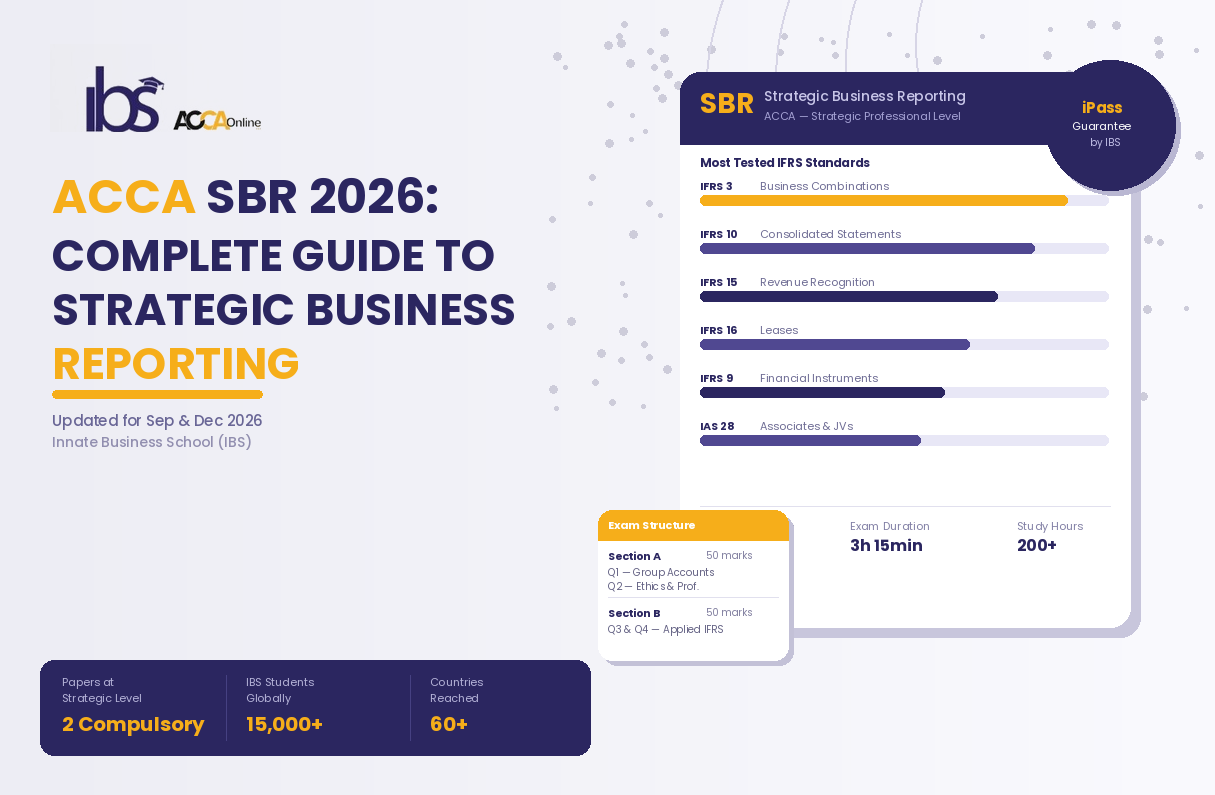
The SBR exam is 3 hours and 15 minutes long and is worth 100 marks in total. All four questions must be answered. There is no choice in SBR.
Section A (50 marks total)
| Question | Marks | What It Tests |
|---|---|---|
| Question 1 | Approx. 30 marks | Group financial statements or group reporting issues. Tests consolidation, goodwill, associates, NCI, and related IFRS standards (IFRS 3, IFRS 10, IAS 28, IFRS 11). Includes both calculations and written analysis. |
| Question 2 | Approx. 20 marks (includes 2 professional marks) | Ethical and professional issues in corporate reporting. Tests ACCA Code of Ethics, professional judgement, and reporting responsibilities. Includes a requirement for a professional format (memo, briefing note, report). |
Section B (50 marks total)
| Question | Marks | What It Tests |
|---|---|---|
| Question 3 | 25 marks | IAS/IFRS application to a scenario. Covers a wide range of standards. May include management commentary or non-financial reporting elements. |
| Question 4 | 25 marks (includes 2 professional marks) | Current issues and advanced IFRS application. Often includes performance measurement, ESG, integrated reporting, or developments in accounting standards. |
Total professional marks: 4 marks (2 in Q2 and 2 in Q4). These are awarded based on the quality of your professional communication, not just your technical content.
IFRS Standards in SBR: What Gets Tested and How Often
One of the most important things you can do for SBR is understand which IFRS standards are examined most frequently and what the examiner expects from you on each one. Below is a frequency guide based on recent exam sessions.
| IFRS Standard | Topic | Exam Frequency | Key Focus in SBR |
|---|---|---|---|
| IFRS 3 | Business Combinations | Very High | Goodwill calculation, fair value adjustments, NCI measurement, contingent consideration |
| IFRS 10 | Consolidated Financial Statements | Very High | Control assessment, step acquisitions, disposal of subsidiaries |
| IAS 28 | Associates and Joint Ventures | High | Equity method, significant influence, impairment of investment in associate |
| IFRS 11 | Joint Arrangements | Medium-High | Joint operation vs joint venture distinction and accounting treatment |
| IFRS 15 | Revenue Recognition | High | 5-step model application to complex contracts, variable consideration, contract modifications |
| IFRS 16 | Leases | High | Lessee accounting, right-of-use assets, lease liability, modifications |
| IFRS 9 | Financial Instruments | High | Classification and measurement, impairment (ECL model), hedge accounting basics |
| IAS 36 | Impairment of Assets | Medium-High | Goodwill impairment, CGU identification, value in use vs fair value less costs |
| IAS 37 | Provisions, Contingent Liabilities | Medium | Recognition criteria, measurement, contingent assets and liabilities disclosure |
| IFRS 13 | Fair Value Measurement | Medium | Fair value hierarchy, valuation techniques, disclosures |
| IAS 38 | Intangible Assets | Medium | Recognition criteria, internally generated intangibles, amortisation |
| IFRS 2 | Share-Based Payments | Medium | Equity-settled vs cash-settled, measurement date, vesting conditions |
| IAS 12 | Income Taxes | Medium | Deferred tax on temporary differences, recognition in OCI vs P&L |
| IFRS 8 | Operating Segments | Lower-Medium | Segmental reporting criteria and disclosure requirements |
| Integrated Reporting | IR Framework (IIRC) | Growing | Six capitals, value creation, connectivity of information |
| Sustainability/ESG | Non-financial Reporting | Growing | IFRS S1/S2, ISSB standards, climate-related disclosures |
IBS Study Tip: Do not try to memorise every paragraph of every standard. Instead, understand the core principle of each standard and practise applying it to scenarios. In SBR, explaining why a standard applies is worth more than reciting what it says.
The 4 Professional Skills Tested in SBR
SBR is one of the papers where ACCA awards professional skills marks. These 4 marks are separate from technical marks and reward the quality of your professional behaviour as a finance professional.
- Analysis and Evaluation — The ability to assess information critically, identify what is relevant, prioritise issues, and reach logical conclusions. In SBR, this means going beyond surface observations in a scenario and identifying the underlying reporting issue, its cause, and its implications for stakeholders.
- Scepticism — A questioning mindset is fundamental to professional accountancy. In SBR, scepticism means challenging information that seems inconsistent, questioning management assumptions, and identifying where reporting choices may not give a true and fair view.
- Communication — Accountants must communicate complex financial information clearly to non-specialist audiences. SBR rewards answers that are well-structured, use appropriate headings, write in clear paragraphs, and match the format requested (memo, briefing note, report, letter).
- Commercial Acumen — Understanding the commercial context surrounding a reporting scenario. Why does a company structure a transaction in a particular way? What are the business incentives behind a reporting choice? SBR rewards candidates who connect financial reporting to business reality.
IBS Study Tip: Professional marks are lost most often because students ignore the format requirement in the question. If the examiner asks for a briefing note to the Audit Committee, write a briefing note with a proper heading, date, subject line, and sign-off. These small things earn marks.
SBR Syllabus: The 6 Core Areas
The SBR syllabus is divided into six main areas. Understanding what each area covers and how it is examined helps you plan your study time more effectively.
| Syllabus Area | Key Topics | Exam Weight |
|---|---|---|
| A: Fundamental Ethics and Professional Principles | ACCA Code of Ethics, professional behaviour, conceptual framework, ethical issues in corporate reporting | 10–15% |
| B: The Financial Reporting Framework | Conceptual Framework for Financial Reporting, IASB structure, role of FRC, regulatory environment | 10% |
| C: Reporting Financial Performance | Statement of P&L and OCI, Statement of Changes in Equity, Cash Flow Statement, Segment Reporting (IFRS 8) | 15–20% |
| D: Financial Statements of Group Entities | Consolidation (IFRS 10), Business Combinations (IFRS 3), Associates (IAS 28), Joint Arrangements (IFRS 11) | 30–35% |
| E: Interpret Financial Statements for Stakeholders | Financial analysis, non-financial reporting, ESG factors, Integrated Reporting, sustainability disclosures | 15–20% |
| F: Changes in Accounting Regulations | New and revised IFRS, ISSB sustainability standards, convergence projects, current issues in reporting | 10% |
Group entities (Section D) consistently carries the highest marks in the exam. Do not under-prepare this area. Consolidation, goodwill, and business combination questions are virtually guaranteed in every SBR sitting.
SBR Study Plan: Week by Week for September 2026
Most students have 12 to 16 weeks to prepare for SBR. Below is IBS's recommended study plan for a student targeting the September 2026 exam, with classes starting in June 2026.
| Phase | Weeks | Focus |
|---|---|---|
| Phase 1: Foundation | Weeks 1–3 | Revise FR (F7) foundations: consolidation basics, key IFRS standards (IFRS 15, 16, 9, IAS 36, 37). Identify your weak areas from FR before adding SBR complexity. |
| Phase 2: Core SBR Syllabus | Weeks 4–7 | Study SBR-specific content: advanced group accounting (IFRS 3, IFRS 10, IAS 28, IFRS 11), ethics and professional skills, conceptual framework at SBR depth. |
| Phase 3: IFRS Deep Dive | Weeks 8–9 | Cover remaining IFRS standards tested in SBR. Focus on IFRS 2, IAS 12, IFRS 8, IFRS 13, and IAS 38. Study technical articles published by ACCA. |
| Phase 4: Current Issues | Week 10 | Integrated Reporting, ESG and sustainability disclosures, ISSB standards (IFRS S1 and S2), non-financial reporting developments. These appear in Q4 regularly. |
| Phase 5: Question Practice | Weeks 11–13 | Attempt full past paper questions under timed conditions. Focus on writing quality, structure, and professional marks. Review Examiner Reports after each paper. |
| Phase 6: Mock Exams and Final Revision | Weeks 14–16 | Complete at least 2 full mock exams under real exam conditions. Review weak areas. Focus on time management and answer planning. |
IBS Study Tip: The single biggest mistake SBR students make is spending too long on technical reading and too little time on question practice. From Week 6 onwards, you should be attempting at least one past question per study session before reviewing the answer.
How to Answer SBR Questions: The IBS Framework
The technique for answering SBR questions is as important as your technical knowledge. Many students fail SBR not because they lack knowledge, but because they cannot apply it effectively under exam conditions.
Step 1: Read the Requirements First
Before reading the scenario, read every requirement carefully. Underline the action verb (discuss, evaluate, advise, explain, prepare) and the subject matter. This tells you exactly what to focus on when reading the scenario.
Do not fall into the trap most students fall into: reading the scenario in full, then reading the requirements, then re-reading the scenario. Read requirements first, always.
Step 2: Read the Scenario Actively
With the requirements in mind, read the scenario with a pen in hand. Identify and mark every piece of information that connects to a requirement. In SBR, scenarios are dense with details, and not every detail is relevant to every question. Learning to prioritise is a critical skill.
Step 3: Plan Your Answer Before Writing
Spend 3 to 5 minutes planning your answer structure before writing a single word. Identify the key issues, the relevant standards, and the logical flow of your argument. A well-planned answer is almost always a higher-scoring answer.
Step 4: Use the State-Apply-Conclude Structure
For each reporting issue in your answer, follow this structure:
- State: Identify the accounting issue from the scenario
- Apply: Apply the relevant IFRS standard or principle to the specific facts of the scenario
- Conclude: State the correct accounting treatment, or give a recommendation with justification
This structure ensures your answer stays relevant to the scenario rather than drifting into generic textbook explanations, which score poorly in SBR.
Step 5: Manage Your Time Ruthlessly
With 3 hours and 15 minutes for 100 marks, you have approximately 1 minute 57 seconds per mark. Practise this discipline in every mock exam you attempt.
| Section | Marks | Suggested Time |
|---|---|---|
| Section A: Question 1 | ~30 marks | ~58 minutes |
| Section A: Question 2 | ~20 marks | ~39 minutes |
| Section B: Question 3 | 25 marks | ~49 minutes |
| Section B: Question 4 | 25 marks | ~49 minutes |
IBS Study Tip: Never spend more than your allocated time on any question. A partially answered Question 3 will always give you more marks than a perfectly answered Question 1 that left Question 3 blank. Move on and come back if time allows.
Common Mistakes SBR Students Make (And How to Avoid Them)
Based on ACCA Examiner Reports and IBS faculty feedback, here are the most common mistakes students from Pakistan, India, and across South Asia make in SBR:
| Common Mistake | Why It Costs Marks | How to Avoid It |
|---|---|---|
| Regurgitating the standard instead of applying it | The examiner already knows the standard. Marks come from applying it to the specific scenario. | Always link your technical knowledge directly to the facts in the question. |
| Ignoring the professional format requirement | Professional marks (2 per question) require correct format: memo, report, briefing note, email. | Read the requirement carefully. Write the correct document format with heading, date, and sign-off. |
| Spending too long on calculations in Q1 | SBR Q1 rewards discussion and analysis, not just numerical accuracy. | Keep calculations clean and brief. Spend more time on the written analysis that surrounds them. |
| Writing generic ethics answers | General ethics points score nothing. The examiner wants application to the specific ethical issue in the scenario. | Identify the specific ethical threat, explain why it is a problem in this context, and recommend a specific course of action. |
| Not covering all requirements in a question | Multi-part requirements are common. Students often write too much on Part A and run out of time for Part B. | Plan time per requirement before writing. Move on strictly when time is up. |
| Neglecting current issues and ESG | Q4 regularly tests integrated reporting, sustainability disclosures, and current IFRS developments. | Spend one full week on current issues. Read ACCA's technical articles and the IFRS Foundation's ISSB updates. |
| Weak financial analysis in Q3/Q4 | Students calculate ratios but do not say anything meaningful about them. | Identify the underlying business issue behind the ratio. Comment on the implication for the specific stakeholder mentioned in the question. |
SBR and Your Career: Why This Paper Matters Beyond the Exam
SBR is not just an exam to pass. The skills it develops are directly used in some of the most valuable and well-compensated roles in finance.
| Career Role | How SBR Skills Apply | Salary Range in Pakistan (PKR/month) |
|---|---|---|
| Financial Reporting Manager | Prepares and reviews IFRS-compliant financial statements for listed companies | 250,000 – 600,000 |
| External Audit Senior / Manager | Evaluates client financial statements for compliance with IFRS; assesses accounting judgements | 200,000 – 500,000 |
| Corporate Finance Analyst | Analyses financial statements for M&A due diligence and valuation | 200,000 – 450,000 |
| Group Financial Controller | Oversees group consolidation, intercompany eliminations, and group reporting | 400,000 – 900,000 |
| CFO (SME/Corporate) | Makes strategic financial reporting decisions and manages stakeholder communication | 700,000 – 2,000,000+ |
| Sustainability Reporting Specialist | Emerging role: prepares ESG and integrated reports under ISSB and GRI frameworks | 200,000 – 500,000 (rapidly growing) |
In the Gulf markets (UAE, Saudi Arabia, Qatar), ACCA SBR-qualified professionals command salaries of AED 15,000 – 30,000 per month in financial reporting and audit roles. The IFRS expertise developed through SBR is directly transferable to every international market.
Is SBR Harder Than FR? An Honest Comparison
This is one of the most frequently asked questions by ACCA students approaching the Strategic Professional level. The answer is: yes, SBR is harder than FR, but not for the reason most students expect.
SBR is harder because:
- It requires you to write more and calculate less than FR, which is a different skill set
- The scenarios are longer and more complex, requiring better judgement about what is relevant
- There is no single correct answer to many SBR questions, only better or worse-justified ones
- The professional skills element adds a dimension that FR does not have
- Current issues and ESG cannot be revised from a textbook alone
SBR is not harder in terms of raw technical content. Most students who struggled with FR's group accounts calculations actually find SBR's written approach more comfortable once they adjust. The key is accepting that SBR is a different type of exam and preparing accordingly.
Students who approach SBR as a harder version of FR typically struggle. Students who approach it as a professional communication and application paper typically succeed.
Study SBR with Innate Business School for September or December 2026
At Innate Business School (IBS), we have been preparing ACCA students for the Strategic Professional level for over 13 years. SBR is one of our highest-demand courses and our results reflect the quality of our preparation.
When you study SBR with IBS, you benefit from:
- Live sessions in Urdu/Hindi by Sir Yasir Yamin — taught in the language you think in, so no concept gets lost in translation
- The iPass Guarantee — our structured commitment to students who attend sessions, complete assignments, and sit their exams
- Exam-focused question practice — past paper walkthroughs, mock exams, and answer review sessions built around the SBR examiner's actual marking approach
- Professional skills coaching — dedicated sessions on how to earn professional marks through format, communication quality, and structured reasoning
- Current issues coverage — updated for 2026 exam sessions including ISSB sustainability standards, IFRS S1 and S2, and integrated reporting developments
- WhatsApp tutor support — direct access to faculty support between sessions, so you are never stuck on a concept alone
IBS has helped 15,000+ alumni build careers at Big Four firms, MNCs, banks, and consulting firms across 60+ countries. If you are serious about SBR, we are serious about your success.
SBR September 2026 (Urdu/Hindi) — Now Open
Valid until 15 Sep 2026
SBR December 2026 (Urdu/Hindi) — Now Open
Valid until 15 Dec 2026
Frequently Asked Questions
Most students attempt SBR as their first Strategic Professional paper, immediately after completing their Applied Skills level. You must have passed or received exemptions for all Applied Skills papers before sitting Strategic Professional. SBR is a strong first choice because its IFRS content builds directly on FR, which you have recently completed.
Yes, you can. However, both are demanding papers and require significant preparation time. Most students who attempt both in the same session either have very strong FR foundations or have extended study time available. IBS advisors can help you decide whether sitting both together suits your situation.
ACCA recommends approximately 200 study hours for SBR. In practice, most IBS students who pass first time spend 180 to 220 hours across 12 to 16 weeks of structured preparation.
SBR has one of the higher pass rates among ACCA Strategic Professional papers, typically around 48 to 52% globally. However, pass rates vary significantly by exam session and by quality of preparation. Students with structured tuition and regular question practice consistently outperform the global average.
Yes. All ACCA Strategic Professional exams are now Computer-Based Exams (CBE). SBR is a session CBE, meaning it is available in the March, June, September, and December exam sessions only, not on demand.
You can retake SBR in any subsequent exam session. The syllabus remains the same across sessions. For retakers, IBS recommends a focused debrief of the failed attempt to identify specific weak areas before beginning preparation again. Our iPass Guarantee also supports students who meet its attendance and practice requirements.
Based on recent exam history, the most consistently tested standards are IFRS 3 (Business Combinations), IFRS 10 (Consolidated Financial Statements), IAS 28 (Associates), IFRS 15 (Revenue), IFRS 16 (Leases), and IFRS 9 (Financial Instruments). Emerging areas including ISSB sustainability standards (IFRS S1 and S2) are increasingly appearing in Question 4.
Yes. IBS delivers SBR entirely online through live sessions in Urdu/Hindi, with recorded lecture access, WhatsApp support, and mock exam practice. Students from Pakistan, India, Nepal, Saudi Arabia, the UAE, and the UK all study with IBS for SBR.
SBR uses professional marking that rewards the quality of reasoning, not perfection. You do not need to identify every issue in a scenario to pass. Markers are looking for clear application of relevant standards to the specific scenario, professional communication, and logical conclusions. A well-structured answer covering the key points thoroughly will always outscore a rushed attempt to cover everything superficially.
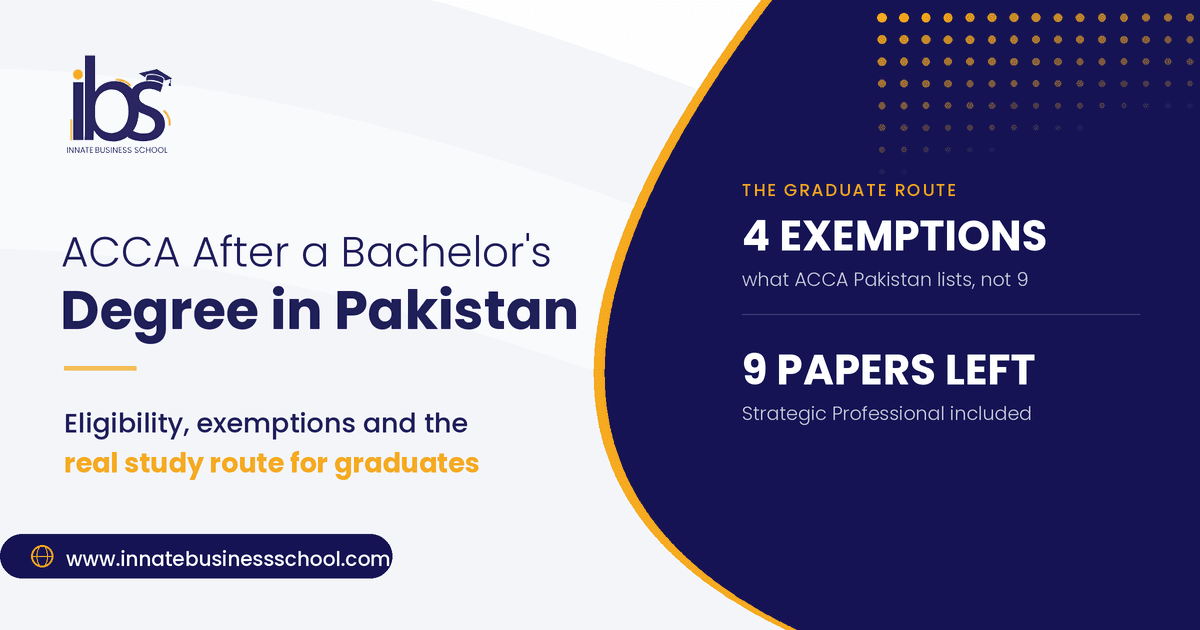
ACCA After a Bachelor's Degree in Pakistan 2026: Eligibility, Exemptions and Study Route
Explore ACCA after a bachelor's degree in Pakistan: eligibility, exemptions, papers, costs and a practical study route f...

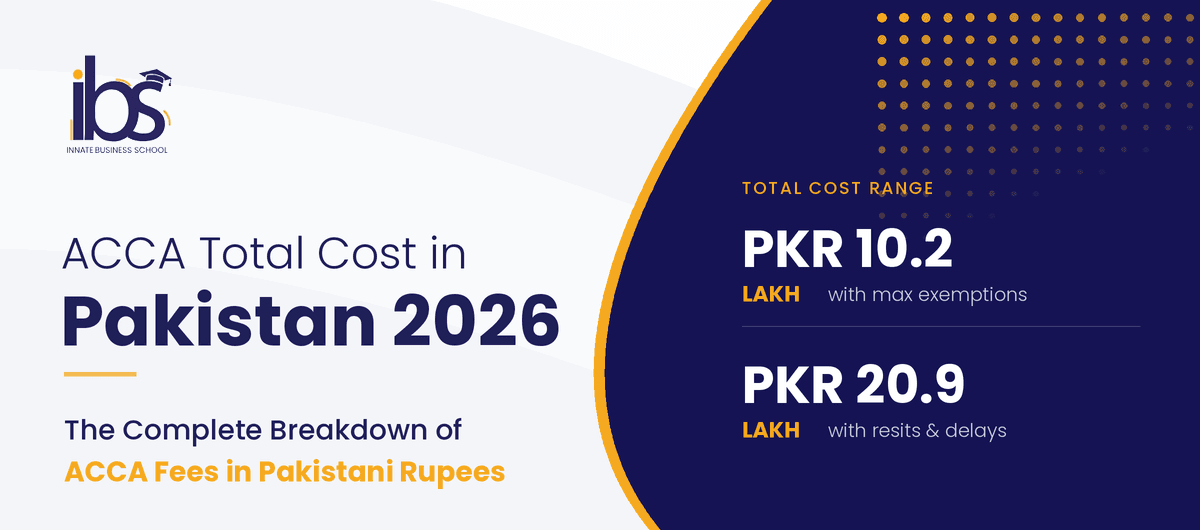
ACCA Total Cost in Pakistan 2026: Full PKR Breakdown
ACCA total cost in Pakistan 2026: PKR 10.2 to 20.9 lakh. Full per-paper fee breakdown in rupees, exemption costs, hidden...
 Join WhatsApp Community