


Career
ACCA vs CA in Pakistan 2026: Differences, Salary, Exemptions and Which Is Better
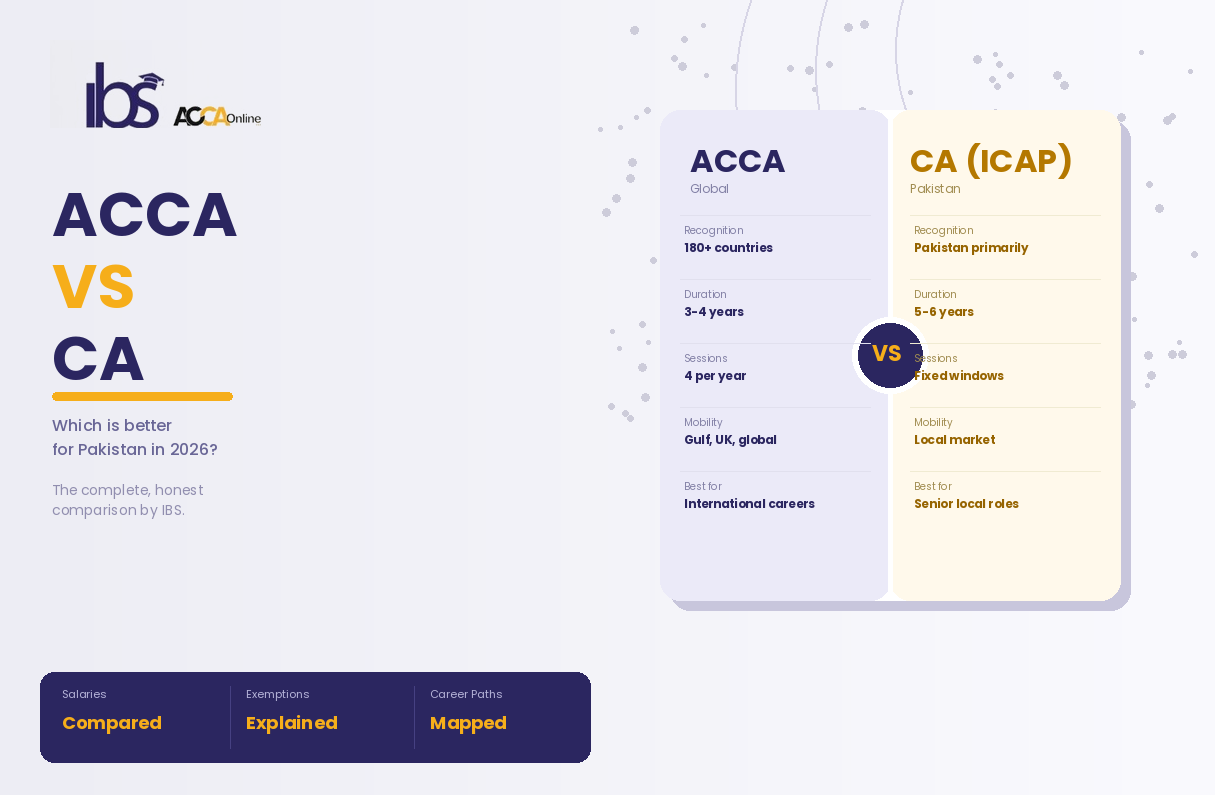
ACCA vs CA is one of the most searched questions among Pakistani students entering the world of professional accountancy. Both qualifications are respected. Both lead to strong careers. Both are demanding. And yet they are fundamentally different in how they work, what they cost, how long they take, where they are recognised, and what kind of career they lead to.
This guide gives you a complete, honest comparison of ACCA and CA in Pakistan. Not a promotional piece for either. A structured analysis of what each qualification is, how they differ, which pays more, which is harder, how exemptions work between them, and most importantly: which one is right for you based on your specific situation.
At Innate Business School (IBS), we teach ACCA at Applied Skills and Strategic Professional level. We have 15,000+ alumni who have made this decision and built careers on both sides of it. This guide reflects what we have learned from thousands of those journeys.
What Are ACCA and CA? A Clear Starting Point
What Is ACCA?
ACCA stands for the Association of Chartered Certified Accountants. It is a UK-based international professional accountancy body and one of the largest in the world by membership. The ACCA qualification consists of 13 papers divided across three levels: Applied Knowledge, Applied Skills, and Strategic Professional. It also requires 36 months of relevant practical experience and completion of an Ethics and Professional Skills Module.
ACCA is recognised in 180+ countries and is the qualification of choice for finance professionals working in international audit, financial reporting, corporate finance, tax, and management accounting. For Pakistani students, it is particularly valued for international career mobility, especially in the Gulf (UAE, Saudi Arabia, Qatar) and the UK. The scope of ACCA in Pakistan in terms of jobs, salaries, and career paths is covered in a dedicated scope of ACCA in Pakistan guide.
What Is CA in Pakistan?
CA in Pakistan refers to the qualification awarded by ICAP, the Institute of Chartered Accountants of Pakistan. It is Pakistan's domestic chartered accountancy qualification. The CA qualification involves four stages: Certificate in Accounting and Finance (CAF), Certification in Finance, Accounting and Business (CFAB), Professional Competence Examination (PCEX), and Multi Subject Assessment (MSA), alongside a mandatory traineeship (articleship) of approximately 3.5 years.
CA (ICAP) is Pakistan's most prestigious local accountancy credential. It carries strong brand recognition among Pakistani employers, particularly at the Big Four audit firms' Pakistan practices, and at senior leadership levels of major local corporations.
ACCA and CA Difference: The 8 Most Important Dimensions
The difference between CA and ACCA in Pakistan is not simply about one being better than the other. They are different instruments built for different purposes. Here are the dimensions that matter most.
| Dimension | ACCA | CA (ICAP) |
|---|---|---|
| Awarding body | ACCA UK (global) | ICAP Pakistan (local) |
| Recognition | 180+ countries globally | Pakistan and South Asia primarily |
| Number of papers | 13 papers across 3 levels | Approximately 15-16 modules across 4 stages |
| Typical completion time | 3 to 4 years | 5 to 6 years (with mandatory articleship) |
| Articleship/PER | 36 months PER (can run concurrently) | 3.5 year mandatory articleship (sequential) |
| Exam flexibility | 4 sessions per year, sit when ready | Fixed exam windows, structured progression |
| Language of instruction | English | English |
| International mobility | Very high (Gulf, UK, global) | Limited (primarily Pakistan) |
| Entry requirement | Intermediate / O Levels / Matric | Intermediate or A Levels (specified grades) |
| Cost (approximate) | PKR 1.2M to 1.7M total | PKR 800K to 1.5M total (varies) |
Important clarification: CA in Pakistan (ICAP) and ICAEW (UK Institute of Chartered Accountants in England and Wales) are different qualifications. When this guide refers to CA, it means ICAP. When companies in Pakistan advertise for 'CA', they are almost always referring to ICAP unless they are a UK-linked entity.
CA or ACCA: Which Is Better in Pakistan?
This is the most searched version of this question and also the one with the most nuanced answer. The honest response is: neither is universally better. Each is better for a specific type of student with specific goals.
ACCA Is Better If:
- You want international career mobility, particularly in the Gulf (UAE, Saudi Arabia, Qatar) or UK
- You want a faster route to qualification (3 to 4 years vs 5 to 6 years)
- You have a B.Com or BBA degree and want to leverage exemptions to complete ACCA quickly
- You want the flexibility to study online and sit exams four times per year on your own schedule
- You are working and want a qualification that can be completed alongside employment
- You want to work in financial reporting, management accounting, or international audit
CA (ICAP) Is Better If:
- Your primary goal is to build a career within Pakistan at the most senior levels of local corporates
- You want the most prestigious local credential for senior audit partner roles in Pakistan's Big Four offices
- You are prepared to commit to 3.5 years of mandatory articleship as a structured training route
- You have the academic profile (strong Intermediate results) and the long-term commitment the qualification demands
- You are targeting family business finance leadership or senior government-linked finance roles in Pakistan
IBS Perspective: Many of our most successful alumni hold both qualifications. They started with ACCA for the faster entry and global recognition, then pursued ICAP CA for the local brand credibility. This combination is particularly powerful for students targeting CFO and Finance Director roles at major Pakistani corporations. However, it requires significant time and investment, and is not necessary for most career paths.
Is ACCA Harder Than CA? An Honest Assessment
This question comes up consistently. The answer depends on what you mean by harder.
| Dimension | ACCA | CA (ICAP) |
|---|---|---|
| Global pass rates | 35% to 55% per paper | Historically lower, particularly at later stages |
| Number of sittings | Up to 4 per year per paper | Fixed exam windows, less flexibility |
| Exam style | Application and professional judgement-focused | Technically demanding, calculation-heavy at earlier stages |
| Failure consequence | Retry next session, maintain momentum | Failure can delay progression by 6 months or more |
| Time pressure | 3 to 4 hours per paper | Multiple papers in condensed exam periods |
| Subject breadth | 13 papers covering full finance spectrum | Similar breadth across 4 stages |
ACCA is not easier than CA. It is differently demanding. ACCA tests professional application and judgement under time pressure. CA tests technical depth across a structured progression. Students who struggle with self-directed study and prefer a more structured institutional pathway sometimes find CA's articleship model easier to navigate. Students who prefer flexibility, international content, and online learning often find ACCA a better fit.
For a detailed look at how each ACCA paper works and what each one demands, the complete guide to ACCA papers covers all 13 papers with difficulty ratings, study hours, and exam strategy.
CA vs ACCA Salary in Pakistan: What the Numbers Actually Look Like
Salary comparisons between CA and ACCA in Pakistan are frequently misrepresented. The truth is that at the entry level, the gap is small. At the senior level, the gap depends more on experience, sector, and employer than on the qualification itself.
| Career Stage | ACCA Salary (PKR/month) | CA (ICAP) Salary (PKR/month) | Notes |
|---|---|---|---|
| Trainee / Student | 35,000 to 90,000 | 40,000 to 100,000 | CA articleship stipend can be structured differently |
| Newly qualified (0-2 yrs) | 80,000 to 200,000 | 120,000 to 250,000 | CA tends to command higher starting salaries at Big Four |
| Mid-career (3-6 yrs) | 200,000 to 600,000 | 250,000 to 700,000 | Gap narrows significantly with experience |
| Senior (7-12 yrs) | 500,000 to 1,500,000 | 600,000 to 2,000,000 | CA premium at senior local corporate roles |
| Leadership / CFO | 700,000 to 2,000,000+ | 1,000,000 to 3,000,000+ | Both qualifications lead to equivalent levels |
| Gulf market (UAE, Saudi) | AED 15,000 to 35,000/mo | Limited recognition | ACCA premium in Gulf and international markets |
The key insight on CA vs ACCA salary in Pakistan: CA tends to command higher starting salaries at Big Four Pakistan offices and senior local corporate roles. ACCA commands premium compensation in the Gulf and international markets. For professionals who stay in Pakistan throughout their career at senior levels, CA's local brand premium can be meaningful. For professionals who spend any significant time working internationally, ACCA's global recognition is the more valuable asset.
ACCA Exemptions for CA Students: How Many and What They Cover
One of the most practically important aspects of the ACCA vs CA comparison for Pakistani students is the exemption system. Students who have already started or completed CA can claim exemptions from some ACCA papers, and vice versa.
ACCA Exemptions for CA (ICAP) Students
CA (ICAP) students and affiliates are entitled to significant exemptions when they join ACCA. ACCA recognises ICAP qualifications as equivalent to certain ACCA papers and grants exemptions accordingly.
| CA (ICAP) Stage Completed | Typical ACCA Exemptions | Papers Remaining |
|---|---|---|
| CAF (Certificate in Accounting and Finance) | Up to 5 Applied Knowledge and early Applied Skills papers | 8 to 9 papers remaining |
| CFAB (Certification in Finance, Accounting and Business) | Up to 7 papers | 6 to 7 papers remaining |
| Full CA (ICAP) qualified | Up to 9 papers including Applied Knowledge and most Applied Skills | 4 papers at Strategic Professional level remaining |
Verify your exact exemptions: Exemption entitlements depend on your specific CA exam results and the year you completed each stage. Use the official ACCA exemption calculator at accaglobal.com to check your exact entitlements, or contact IBS and we will help you calculate them for free.
Note that exemption fees apply even when papers are waived. Each exempted paper costs the same as sitting it. Factor this into your total cost calculation when deciding whether to claim exemptions or attempt the paper from scratch. The complete ACCA fees guide covers exemption fees in PKR alongside all other ACCA Global charges.
CA Exemptions After ACCA: Going the Other Direction
ACCA members and affiliates who want to additionally obtain the CA (ICAP) qualification can also claim exemptions from ICAP's examination structure. This is less common but increasingly relevant for ACCA professionals who want to strengthen their local Pakistan credentials.
| ACCA Status | ICAP CA Exemptions | Notes |
|---|---|---|
| ACCA Affiliate (all exams passed) | Exemptions from CAF and some CFAB papers | Still requires completing PCEX and MSA stages |
| ACCA Member (with experience) | Potentially broader exemptions including CFAB | Verification required through ICAP directly |
The number of CA exemptions after ACCA is not fixed by a single published table. ICAP grants exemptions on a case-by-case basis depending on your ACCA papers completed and results. Contact ICAP directly for a formal exemption assessment if you are pursuing this route.
ACCA vs CA in Pakistan: What Is Different About the Local Context
The ACCA vs CA debate plays out slightly differently in Pakistan than it does globally, due to some Pakistan-specific market dynamics.
Big Four Audit Firms in Pakistan
PwC, EY, Deloitte, and KPMG in Pakistan recruit both ACCA trainees and CA articleship students. Historically, senior partner-track positions at these firms' Pakistan offices have been dominated by CA (ICAP) holders. However, this is changing. ACCA members are increasingly reaching senior levels at Big Four Pakistan offices, and the firms openly recruit both qualifications for audit associate and manager roles.
MNCs and International Companies in Pakistan
Multinational corporations operating in Pakistan (Unilever, Nestle, Shell, ExxonMobil, Standard Chartered, Citibank, McKinsey, and others) typically prefer or accept ACCA qualifications, particularly for finance roles where IFRS reporting, management accounting, and international financial standards are central. The ACCA qualification's alignment with global standards is a natural fit for MNC finance functions.
Local Corporates and Family Conglomerates
Pakistan's large family-owned conglomerates and local industrial groups have traditionally favoured CA (ICAP) for their senior finance leadership roles. This is changing as younger leadership generations and international exposure broaden the qualification landscape, but CA's local brand remains influential in these contexts.
Gulf Market Demand from Pakistan
The UAE, Saudi Arabia, Qatar, and Bahrain have large communities of Pakistani finance professionals. ACCA is the dominant qualification among these communities and is widely recognised by Gulf employers. Pakistani ACCA professionals in the Gulf typically earn 3 to 5 times the equivalent Pakistan salary, making the ACCA route particularly attractive for students who anticipate working internationally at any point in their career.
For a detailed salary breakdown across Pakistan and the Gulf, the ACCA jobs in Pakistan guide covers roles, salaries, and career paths by city and sector.
Is ACCA and CA the Same Qualification?
No. ACCA and CA are not the same qualification. They are issued by different bodies, recognised in different geographies, structured differently, and carry different market positions in Pakistan.
They share some common ground: both cover financial accounting, auditing, taxation, and management accounting in their curricula. Both are professional qualifications rather than academic degrees. Both require practical experience alongside exam completion. Both are respected credentials in Pakistan's finance job market.
The common ground is why students sometimes ask whether they are the same. They are not. Choosing between them requires understanding what each does for your specific career goals, not treating them as interchangeable alternatives.
How to Decide: A Practical Framework for Pakistani Students
Rather than telling you which is better in the abstract, here is a decision framework based on the questions that actually determine which qualification is right for each individual.
| Your Situation | Recommended Route | Reason |
|---|---|---|
| Fresh student, strong A-levels, wants Big Four audit career in Pakistan long-term | CA (ICAP) | Local brand premium at senior level, Big Four partner track historically dominated by CA |
| Fresh student, Intermediate or B.Com, wants international career within 5 years | ACCA | Global recognition, faster completion, Gulf and UK market demand |
| Working professional, wants to qualify while employed | ACCA | 4 sessions per year, flexible CBE format, PER can run concurrently with employment |
| B.Com or BBA graduate wanting fastest route to qualification | ACCA with exemptions | Up to 9 exemptions possible, reducing remaining papers to 4 at Strategic Professional level |
| CA student who wants to add international credential | ACCA (using CA exemptions) | Significant exemptions available, adds global recognition to existing local credential |
| Student targeting MNC or multinational employer in Pakistan | ACCA | MNCs prefer IFRS-trained professionals; ACCA curriculum directly aligned to international standards |
| Student targeting Gulf or UK employment | ACCA | CA (ICAP) has minimal recognition outside Pakistan; ACCA is standard in Gulf and UK markets |
Where Innate Business School Stands in Your ACCA Journey
If you have decided that ACCA is the right route for you, the quality of your preparation determines how quickly you qualify and how confidently you enter the job market. Innate Business School has been preparing ACCA students for over 13 years, with 15,000+ alumni now working at Big Four firms, MNCs, banks, and consulting firms across Pakistan, the Gulf, and beyond.
IBS is taught by Sir Yasir Yamin, an FCCA, FCMA, and ICAEW-qualified professional with experience in audit, industry, and multinational corporate finance. His teaching is built around real professional application, not just exam technique. When an IBS student walks into a job interview after passing their ACCA papers, they carry both the qualification and the professional thinking that employers are actually looking for.
What IBS Offers for Your ACCA Papers
For Applied Skills and Strategic Professional papers, IBS runs session-specific courses in Urdu and Hindi. SBR September 2026 and SBR December 2026 are both currently open. For all other Applied Skills and Strategic Professional papers, visit innatebusinessschool.com/courses.
For students beginning ACCA from Applied Knowledge level, the IBS iPass gives you access to 8 Foundation papers for PKR 7,000 per month with a one-time PKR 5,000 admission fee.
For students with an exam in the next 30 days, the IBS ACCA 30 Days Challenge provides structured crash course preparation with daily planner, weekly live sessions, mock exam, progress checking, and 24/7 support.
Ready to start? WhatsApp IBS on +92 335 048 9489 or visit innatebusinessschool.com for a free consultation on which papers to start with and how to plan your ACCA journey.
Frequently Asked Questions
CA (ICAP) is Pakistan's domestic chartered accountancy qualification, awarded by the Institute of Chartered Accountants of Pakistan and recognised primarily in Pakistan and South Asia. ACCA is an international qualification awarded by the Association of Chartered Certified Accountants (UK) and recognised in 180+ countries. CA takes 5 to 6 years including mandatory articleship. ACCA takes 3 to 4 years with a flexible practical experience requirement. Both cover financial accounting, audit, taxation, and management accounting.
ACCA is better for students who want international career mobility, faster qualification, or a flexible study route. CA (ICAP) is better for students targeting senior positions at the local Big Four offices or large Pakistani corporates where CA's local brand carries a premium. Neither is universally better. The right choice depends on your career goals, timeline, and circumstances.
Both are genuinely demanding. CA has historically lower pass rates at its later stages and involves a 3.5-year mandatory articleship alongside exams. ACCA has global pass rates of 35% to 55% per paper and tests professional application and judgement. ACCA's flexibility (4 sessions per year, on-demand Applied Knowledge exams) makes it more manageable alongside work. CA's structured articleship provides a clear institutional pathway but less flexibility.
At entry level, CA qualified professionals typically earn 10 to 30% more than newly qualified ACCA affiliates in local Pakistani firms. By mid-career (5 to 8 years), the gap narrows significantly and is more dependent on sector, employer, and role than on the qualification. In the Gulf market, ACCA commands significantly higher salaries than CA due to broader recognition.
CA (ICAP) students and members can claim significant exemptions in ACCA. A fully qualified CA (ICAP) is typically eligible for up to 9 exemptions from ACCA papers, leaving only the 4 Strategic Professional papers to complete. The exact number depends on your CA results and stage completed. Use the ACCA exemption calculator at accaglobal.com or contact IBS for a free exemption assessment.
Yes. ACCA affiliates and members can pursue CA (ICAP) and are eligible for exemptions from some ICAP examination stages. The exact exemptions depend on your ACCA papers and experience. Contact ICAP directly for a formal exemption assessment. Many professionals pursue both qualifications to combine global recognition (ACCA) with strong local brand (CA).
ACCA is significantly better for Gulf employment. CA (ICAP) has very limited recognition outside Pakistan. ACCA is the standard professional accountancy qualification across the UAE, Saudi Arabia, Qatar, and Bahrain. Pakistani ACCA professionals in the Gulf typically earn 3 to 5 times the equivalent Pakistan salary.
ACCA typically takes 3 to 4 years to complete, including all 13 papers and the 36-month practical experience requirement that runs concurrently with study. CA (ICAP) typically takes 5 to 6 years including the 3.5-year mandatory articleship which is largely sequential. ACCA's flexibility of four exam sessions per year means students can progress faster if they are well prepared and sit multiple papers per session.
ACCA affiliates and members pursuing CA (ICAP) can claim exemptions from CAF and potentially some CFAB papers. The exact number is assessed by ICAP based on your specific ACCA papers and results. There is no single fixed number. Contact ICAP directly and request a formal exemption assessment with your ACCA results documentation.
CA (ICAP) has historically reported lower pass rates at its senior stages, and the 3.5-year mandatory articleship adds significant demand alongside examinations. ACCA's pass rates range from 35% to 55% per paper globally, and the qualification demands high-level professional application. Both are genuinely difficult. Which feels more difficult depends on your learning style, study approach, and whether you prefer structured institutional training (CA) or flexible self-directed progress (ACCA).
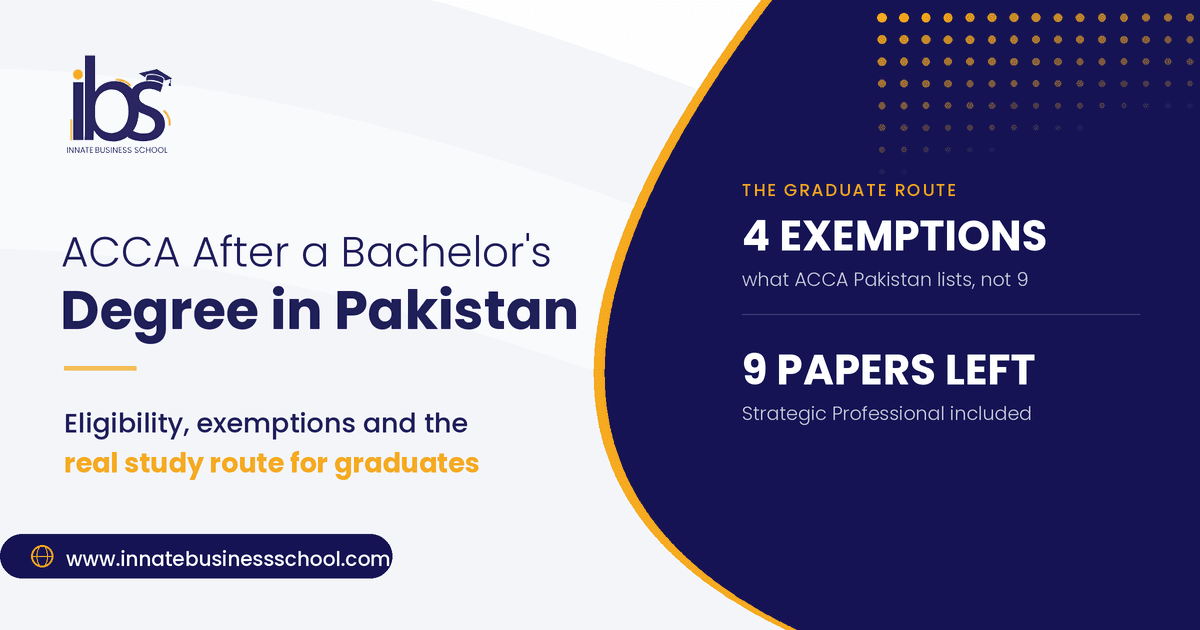
ACCA After a Bachelor's Degree in Pakistan 2026: Eligibility, Exemptions and Study Route
Explore ACCA after a bachelor's degree in Pakistan: eligibility, exemptions, papers, costs and a practical study route f...

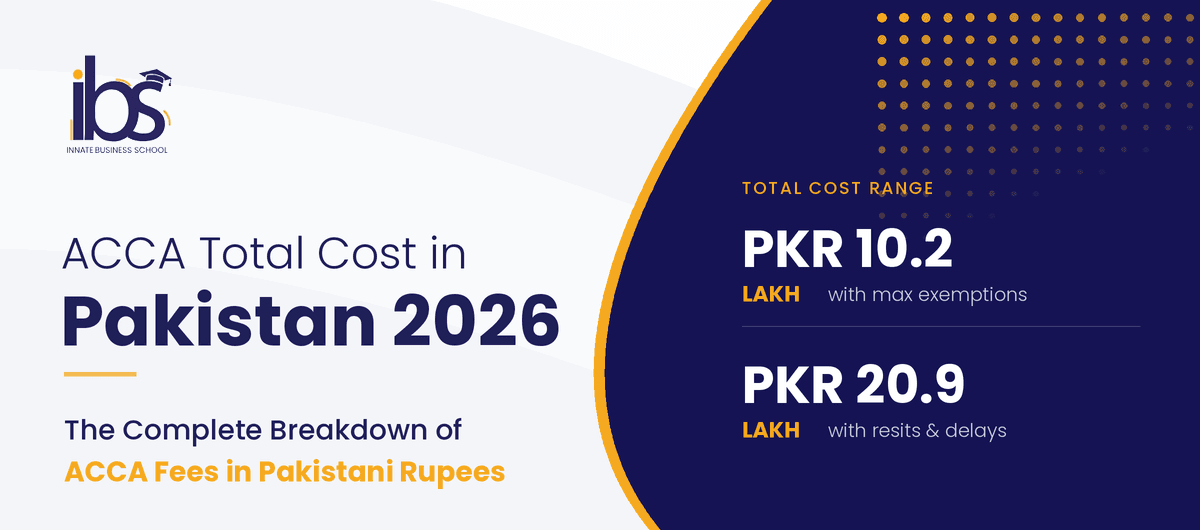
ACCA Total Cost in Pakistan 2026: Full PKR Breakdown
ACCA total cost in Pakistan 2026: PKR 10.2 to 20.9 lakh. Full per-paper fee breakdown in rupees, exemption costs, hidden...
 Join WhatsApp Community