


Finance
Where Is the Accountancy Profession Going? My View on ACCA, AI, Data and the Future of Finance
Whenever a new technology enters the world of finance, the same question comes back:
Will accountants still be relevant?
I believe the answer is very clear.
The accountancy profession will be redefined, but it will not disappear. In fact, for those who are willing to learn, adapt and think beyond traditional bookkeeping, the future of accountancy may become more exciting than ever.
When calculators became common, many people may have thought that mathematicians would no longer be required. But the opposite happened. The role of mathematics did not disappear; it evolved. The calculator removed some of the mechanical burden, but it did not remove the need for logic, interpretation, modelling, judgement and problem-solving.
The same is happening now with artificial intelligence, data analytics, automation and sustainability reporting.
Technology will change how accountants work. It will not remove why accountants are needed.
The Future Accountant Will Not Just Record History
For many years, people outside the profession viewed accountants as people who record transactions, prepare accounts and submit reports. That part of the profession still matters, but it is no longer enough.
The future accountant will be expected to interpret data, understand business models, challenge assumptions, support strategic decisions, manage risk, and explain performance in a language that business leaders can understand.
ACCA has described accountancy as being "redefined", with accountants increasingly becoming drivers of sustainable business, promoters of social value and enablers of new technologies. That is exactly where I believe the profession is heading. Accountants will not only report what happened; they will help organisations understand what should happen next.
AI Will Not Replace Accountants. It Will Challenge Average Accountants.
Artificial intelligence will automate many routine tasks. Data entry, basic reconciliations, standard reports and repetitive analysis will become faster, cheaper and more automated.
But this does not mean the profession is unsafe.
It means the profession will demand better professionals.
ICAEW has highlighted that around three-quarters of finance functions are already using AI to improve efficiency and decision-making, including areas such as audit documentation, understanding reporting standards, reviewing controls and improving data sharing. Research by Chartered Accountants Worldwide and Ipsos also found that 85% of surveyed Chartered Accountants were at least fairly willing to use AI, and many believed AI would make the profession more strategic, with less focus on repeated manual tasks.
This is important. AI is not just a threat. It is also an opportunity.
The accountant of the future will need to ask better questions:
- Is the data reliable?
- Is the output reasonable?
- What judgement is required?
- What are the risks?
- What decision should management take?
- What ethical issues exist?
AI can process information. But professional judgement, business understanding and ethical responsibility will still remain human strengths.
Data Science Is Becoming a Core Finance Skill
Accountants can no longer afford to be afraid of data.
In modern businesses, decisions are made using dashboards, KPIs, forecasts, customer behaviour, operational trends, financial models and risk indicators. This is where data science and accountancy are beginning to meet.
ACCA's own focus on data analytics for finance professionals reflects this shift. Its data analytics learning route covers areas such as big data, data visualisation, analytics techniques, AI, machine learning, Python, R, SQL, data governance and ethical use of data.
This tells us something very clearly: the future finance professional will need to be financially strong and data literate.
For ACCA students, this is a major opportunity. If you combine accounting knowledge with Excel, Power BI, data analytics, AI tools and business communication, you become much more valuable than someone who only knows how to pass journal entries.
The future will reward accountants who can convert data into insight.
Sustainability Is No Longer a Side Topic
Another major shift is sustainability.
In the past, sustainability was often treated as corporate social responsibility - something reported separately, often with nice pictures and broad statements. That world is changing.
Sustainability is now becoming part of business reporting, risk management, investment decisions, governance and long-term value creation. Investors, regulators, lenders and stakeholders increasingly want to know not only how much profit a business made, but how responsibly and sustainably that profit was made.
ACCA's work on sustainability also shows this direction. It has integrated sustainability into its qualification and created dedicated learning pathways such as the Professional Diploma in Sustainability, covering sustainability frameworks, ethics, strategy, reporting and assurance.
This is where accountants have a natural role.
Who understands reporting? Accountants.
Who understands controls? Accountants.
Who understands assurance? Accountants.
Who understands business performance? Accountants.
Who can connect financial impact with non-financial information? Again, accountants.
That is why I believe sustainability will not weaken the profession. It will expand it.
Why ACCA Still Matters in the Future World
I have always seen ACCA as a truly global qualification.
Wherever I travel, I find ACCA students, affiliates and members. It is one of those qualifications that has changed the lives of many people, especially students from countries like Pakistan, India, Bangladesh, Sri Lanka, UAE and many other parts of the world.
For many students, ACCA is not just an exam route. It is a career route. It is a confidence route. It is a way to enter a global profession, build international mobility, and prove yourself in a field that rewards discipline and capability.
ACCA's relevance in the future will depend on how well students use it.
If a student treats ACCA only as a set of exams to be cleared, the benefit will be limited. But if a student uses ACCA to build financial reporting knowledge, business thinking, ethical awareness, analytical ability, communication skills and global confidence, then ACCA can become life-changing.
I say this from personal experience.
My Own Journey: From Doubt to Direction
I did not come from a background where everything was already set for me.
I came from a humble family background. In my 10th and 11th grade years, I was honestly not someone people would have called an exceptional student. I never imagined that I would study something as demanding as Chartered Accountancy.
Like many students, I also believed these exams were extremely difficult. Maybe too difficult.
But I started from the basics.
I had to learn how to study, how to read properly, how to write professionally, and how to think from a business perspective. I had to put in the hours. I had to build discipline. I had to develop clarity.
When I started, I was almost certain the journey would be very difficult. And it was. But over time, it also changed me.
Eventually, I cleared almost all my professional exams in the first attempt - except one, because life should leave you with at least one funny footnote.
More importantly, this profession gave me the ability to take responsibility for my family, build a career, teach thousands of students, work in audit, industry and multinational environments, and understand business from the ground level to strategic decision-making.
I have seen assignments ranging from bookkeeping to strategic investment decisions. And that is the beauty of accountancy. It can take you from the basics of recording transactions to the boardroom discussion of where a business should invest next.
Can Anyone Do It?
I am often asked whether any student can succeed in ACCA or professional accountancy.
My honest answer is: maybe yes - but not casually.
This profession is open to many people, but it rewards those who bring dedication, clarity of thought and a clear goal. You do not need to be born brilliant. You do not need to come from a perfect academic background. But you do need to become serious.
You need to know why you are doing it.
You need to build discipline.
You need to accept the difficulty without being scared of it.
You need proper guidance.
You need to learn how to think, not just how to memorise.
That is why I always tell students that ACCA is not only about intelligence. It is about direction.
The Profession Is Safe - But Not for Those Who Refuse to Evolve
My view is simple.
The accountancy profession is safe, but the comfort zone is not.
If someone wants to remain limited to routine bookkeeping, manual reporting or copy-paste style work, then yes, technology will create pressure. But if someone is willing to grow into analysis, advisory, sustainability, data, AI-enabled finance, reporting quality, controls, governance and strategy, then the future is full of opportunity.
The world will still need professionals who can bring trust to information.
The world will still need people who understand numbers and ethics.
The world will still need accountants who can explain performance, challenge assumptions, protect stakeholders and support better decisions.
That role is not going away. It is becoming more important.
My Message to ACCA Students
If you are an ACCA student today, do not be afraid of the future.
But do not ignore it either.
Learn your core papers properly. Take Financial Accounting, Management Accounting, Financial Reporting, Financial Management, Audit, Tax, SBR and SBL seriously. Build your foundation. Then keep adding future skills - Excel, Power BI, data analytics, AI tools, sustainability reporting, business communication and professional writing.
Do not think of AI as your enemy. Think of it as your calculator moment.
Those who rejected calculators were left behind. Those who used them properly solved bigger problems.
The same will happen now.
The future belongs to accountants who can combine technical knowledge, technology, ethics and business judgement.
That is the future I see for ACCA students.
Not a smaller profession.
A sharper one.
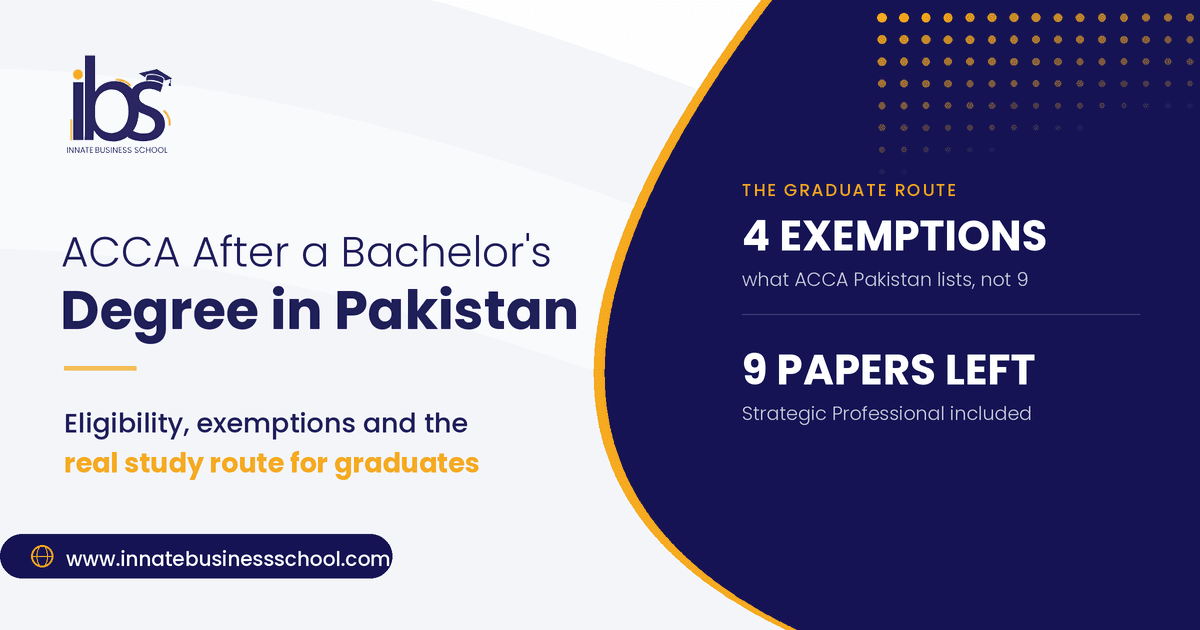
ACCA After a Bachelor's Degree in Pakistan 2026: Eligibility, Exemptions and Study Route
Explore ACCA after a bachelor's degree in Pakistan: eligibility, exemptions, papers, costs and a practical study route f...

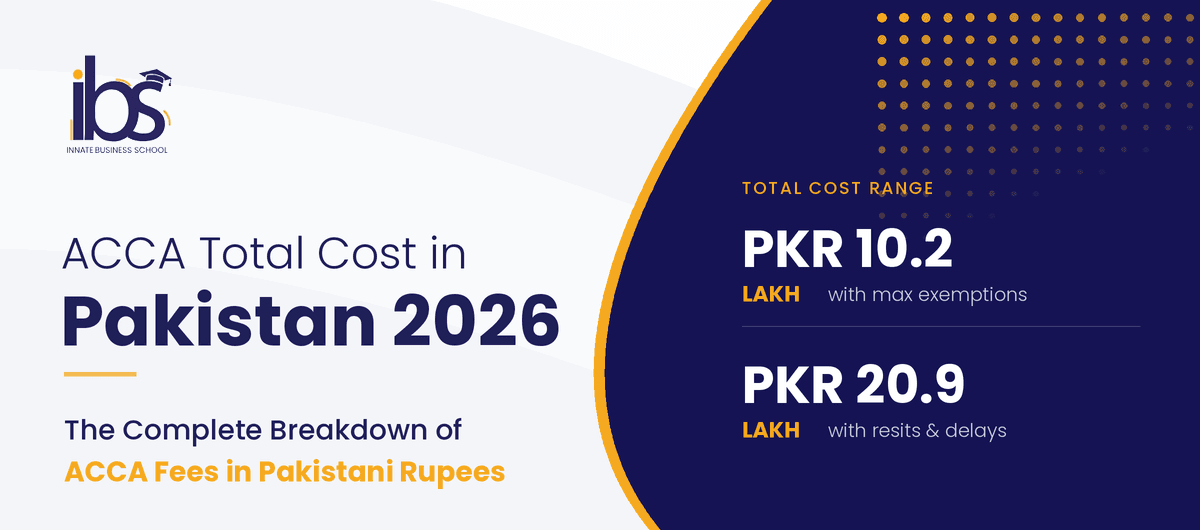
ACCA Total Cost in Pakistan 2026: Full PKR Breakdown
ACCA total cost in Pakistan 2026: PKR 10.2 to 20.9 lakh. Full per-paper fee breakdown in rupees, exemption costs, hidden...
 Join WhatsApp Community